If your building and refurbishment firm works with its own crews, the law requires a record that anyone can check: the start and finish time of each worker's working day, every day, kept for years. When the crew loads up at the yard, stops at the builders' merchant and ends the afternoon on another site, those two times are the first thing to get lost on a paper work report. Below you will find which records the law requires from building and refurbishment firms, what happens if they are missing, what the digital record decree provides for, and what to do this week.
Which records the law requires from building and refurbishment firms
This table brings together the working time obligations that affect any firm carrying out work with its own staff. Use it as a checklist with your workforce.
| Obligation | Rule | In force since | What you must be able to show |
|---|---|---|---|
| Daily working time record | Article 34.9 of the Estatuto de los Trabajadores (Spain's Workers' Statute), added by Real Decreto-ley 8/2019 (Royal Decree-law 8/2019) | 12/05/2019 | Start and finish time of each worker, kept for 4 years |
| Maximum working hours | Article 34.1 of the Estatuto de los Trabajadores | In force | 40 hours a week on an annual average |
| Adapting working hours in hot weather | Real Decreto 486/1997 (Royal Decree 486/1997 on workplace health and safety), with the provision added by Real Decreto-ley 4/2023 | 13/05/2023 | The hours worked on warning days |
| Leave for adverse weather events | Article 37.3.g of the Estatuto de los Trabajadores | In force | Up to 4 paid days, recorded as justified absence |
The Inspección de Trabajo (Spain's Labour Inspectorate) has this issue on its roadmap. The Plan Estratégico de la Inspección de Trabajo 2025-2027 (Labour Inspectorate Strategic Plan 2025-2027, published in the BOE, Spain's Official State Gazette, on 12/09/2025) steps up checks on working time, rest periods and overtime, and promotes an interoperable digital record.
If you also work with subcontractors, the sector has its own obligations, which we cover in how to keep the subcontracting book in construction.
How to record the working time of a crew that moves from site to site
Article 34.9 of the Estatuto de los Trabajadores requires the start and finish time of each worker to be recorded every day. How the system is organised is decided by the collective agreement, an agreement with the workers or, failing both, the company. The record must be available to workers, their representatives and the Inspección de Trabajo for 4 years.
In an office, a clock at the door is enough. On a building site you need to decide beforehand who logs the times and when: whether each tradesperson clocks in from their own phone on arrival, whether the foreman clocks in for the whole crew, and what happens with the time spent in the van between the yard and the site. Put that decision in writing and make sure everyone knows it. A paper report filled in on Friday with the hours for the whole week is a reconstruction from memory and is of little use as a record.
In Gestrab, from Infonet, each worker starts and ends their working day from the mobile app with a single button, in real time or, if necessary, afterwards, and the app works without signal. The program stores the start and finish times and the hours for each day (normal, overtime and special), together with absences and allowances, in a monthly timetable.
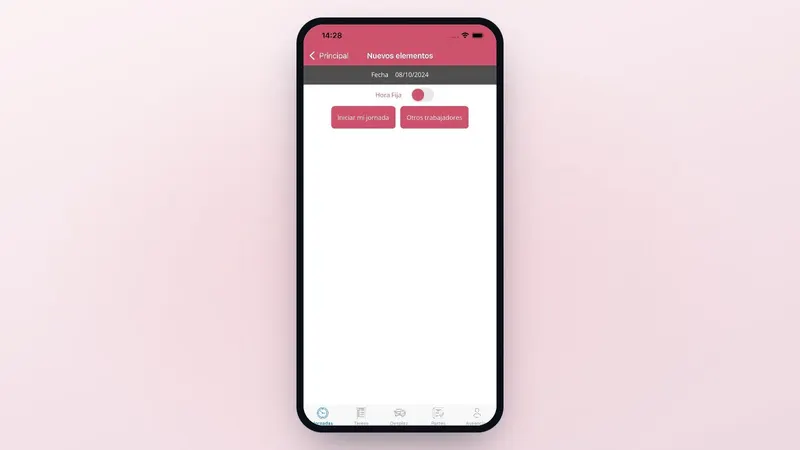
From the same phone the crew fills in work reports, with workers and hours, vehicle and kilometres, start and finish times and the materials used. That way the working day and the work done on each site come from the same place and there is no need to reconcile them by hand.
If today your crews' working hours come from paper reports that someone copies up neatly on Friday, request a Gestrab demo and we will show you how it is recorded from the phone, using a site like yours.
What happens if the Inspectorate does not find the record
The Ley de Infracciones y Sanciones en el Orden Social (Law on Infringements and Sanctions in the Social Order, LISOS, art. 7.5) classes failure to comply with working time record obligations as a serious infringement. A serious fine has three levels and the Inspectorate sets the level according to the case.
Beyond the penalty, the record is your evidence. If a worker claims overtime or a hot day ended early, what counts is what was written down that day. A record with identical hours all week, written with the same pen, does little to protect the company. The same principle applies to reports signed by the client, as we explain in work reports signed by the client.
What the digital working time record decree provides for
The Ministerio de Trabajo (Spain's Ministry of Labour) is processing a royal decree developing article 34 of the Estatuto de los Trabajadores. According to the draft, the record would be digital, traceable and tamper-proof, and would include start, finish, breaks, whether the work is on-site or remote, and ordinary, overtime or additional hours. Any change would need the agreement of both parties and would record who makes it and why. The Inspectorate could access it remotely and in real time, and workers could ask for an immediate copy (Cuatrecasas summary).
The text received an unfavourable opinion from the Consejo de Estado (Spain's Council of State) on 19/03/2026, among other reasons because it would come into force 20 days after publication in the BOE. The Consejo de Ministros (Council of Ministers) meeting of 13/10/2026 did not deal with it. Before changing anything, check in the BOE whether it has already been published.
Until the decree appears in the BOE, what binds you is article 34.9: start and finish time of each worker, every day, kept for 4 years. If it is published as the draft says, there will be 20 days to adapt, so it is wise to prepare now.
When heat or a storm changes working hours on site
Real Decreto-ley 4/2023, in force since 13/05/2023, added to Real Decreto 486/1997 a provision for outdoor work. The measures stem from the risk assessment and may prohibit tasks during the critical hours. Under an orange or red warning from AEMET (Spain's State Meteorological Agency), if the other measures are not enough, it is mandatory to adapt or reduce working hours. To prove that the crew stopped in time, you need the record for those days.
In winter the opposite happens: article 37.3.g of the Estatuto de los Trabajadores gives up to 4 days of paid leave when it is not possible to get to work or there is a serious risk because of an adverse weather event, such as a storm. Record those days as justified absence and not as a day without clocking in. In Gestrab, absences appear in the same monthly timetable as hours.
What to do this week in your firm
- Go through the table with your workforce and check that for each worker you have the start and finish time of every day, going back 4 years.
- Decide in writing who clocks in on site, when, and how travel time from the yard is counted.
- Move working hours and work reports to the phone, so that hours, kilometres and materials are logged on site the same day. These reports also give you site cost control, and you can see whether each refurbishment makes money, as we explain in small refurbishments without losing money.
If you want to see your crews' working hours, work reports and absences in the same construction ERP, request a Gestrab demo or call +34 959 54 07 12.